Michigan House Votes 104-0 to Fight China’s Forced Labor at State Level
Lansing, MI — The Michigan House approved a bill that will prevent the state from entering into economic development deals with companies that appear on the federal Uyghur Forced Labor Prevention Act (UFLPA) Entity List, and require clawback of any payments made to companies who are added to the list in the future.
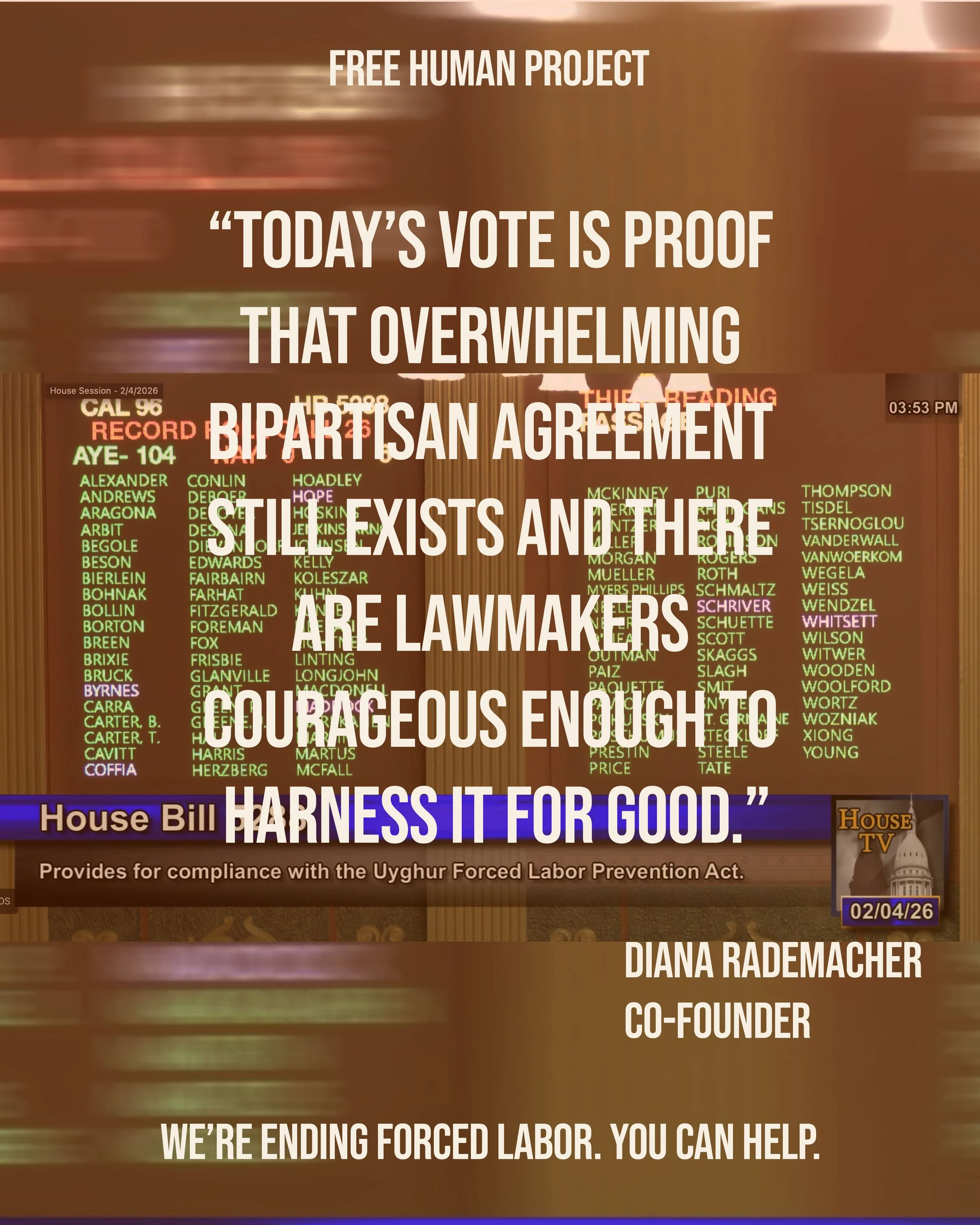
The 104-0 bipartisan vote in favor of HB 5288, sponsored by Bryan Posthumus (R-Cannon Township), is a significant development in the effort to crack down on forced labor in global supply chains and prevent tax dollars from making their way to companies who use modern forms of slavery. Previous efforts have been undertaken at the federal level, but Michigan is one of only two states that have entered economic development contracts with Gotion, a company that has faced bipartisan congressional scrutiny for its connection to suppliers that utilized Uyghur laborers in the Xinjiang Uyghur Autonomous Region. That deal fell through last year after years of lack of progress.
In addition to preventing the state from entering into tax incentive or subsidy contracts with companies who appear on the list, HB 5288 will require economic development deals to include a clawback provision, requiring any company added to the list after the execution of their contract to repay 100% of any payments they’ve received from the state of Michigan plus a 10% penalty. It also requires existing contracts to be amended to include the same provisions.
“Forced labor functions like an illegal subsidy,” said Jared Rodriguez, Co-Founder of the Free Human Project, in committee testimony on the bill last month, “It allows bad actors to artificially lower costs, undercut ethical Michigan companies, and distorts fair competition. When responsible businesses lose contracts to companies that rely on exploitation, Michigan’s economy suffers, and taxpayers unknowingly absorb the risk.”
While extensive work has been done on Chinese and other forced labor prevention at the federal level in recent years, HB 5288 marks a first for state level policy.
“Today’s vote is proof that overwhelming bipartisan agreement still exists and there are lawmakers courageous enough to harness it for good,” said Diana Rademacher, Co-Founder of the Free Human Project, “The federal government pours a tremendous amount of resources into documenting and preventing forced labor goods from entering our markets. It is smart for states to leverage these tools to make sure companies cannot profit off taxpayers while exploiting workers abroad.
We are impressed with Majority Floor Leader Posthumus’ persistent leadership on this issue, applaud the house for its unanimous support, and thank Congressman John Moolenaar for laying so much scaffolding at the federal level on this issue.”
HB 5288 has attracted support from several organizations, including The Free Human Project, Christian Coalition, and the Center for Economic Accountability. In committee, the bill additionally received a letter of support from Congressman John Moolenaar (MI-2) who chairs the U.S. House Select Committee on the Chinese Communist Party. Congressman Moolenaar’s letter of support can be accessed on the committee website. There is an identical bill, SB 715 that was introduced in the Michigan Senate by Senator Joe Bellino (R-Monroe) last year.
The Free Human Project is the only non-profit built to leverage the power of profitability to fight the big money, high-stakes world of human trafficking and forced labor with real financial impact and strong principles. A world free of exploitation is possible. You can help.